BioPykrete: scientists made ice 10 times stronger than concrete

Researchers at the Hebrew University of Jerusalem have created a new ice-based composite called BioPykrete that is ten times stronger than regular ice and matches concrete in compressive strength. The material is also biodegradable — made from water, plant fibers, and an engineered protein — which could make it a practical, low-carbon option for building temporary structures in polar regions where shipping conventional materials is prohibitively expensive.
The recipe
BioPykrete combines two ingredients with a molecular binder. Nano-crystalline cellulose (CNC) — tiny, rigid particles derived from plant cell walls — is mixed into water before freezing. As the water turns to ice, the CNC particles form a three-dimensional internal mesh. A custom-designed chimera protein then acts as a molecular bridge between the ice crystals and the cellulose, locking the two together at the nanoscale. That protein is the key step: per EurekAlert, it doubled both the strength and the energy absorption compared with a cellulose-ice mixture made without it.
The concept has a historical ancestor. During World War II, British scientists developed Pykrete — a mixture of ice and wood pulp — under Project Habakkuk, a plan to build a 600-meter aircraft carrier out of the stuff. It was never built, but the idea proved ice could be toughened. BioPykrete revives that principle using nanotechnology instead of sawdust.
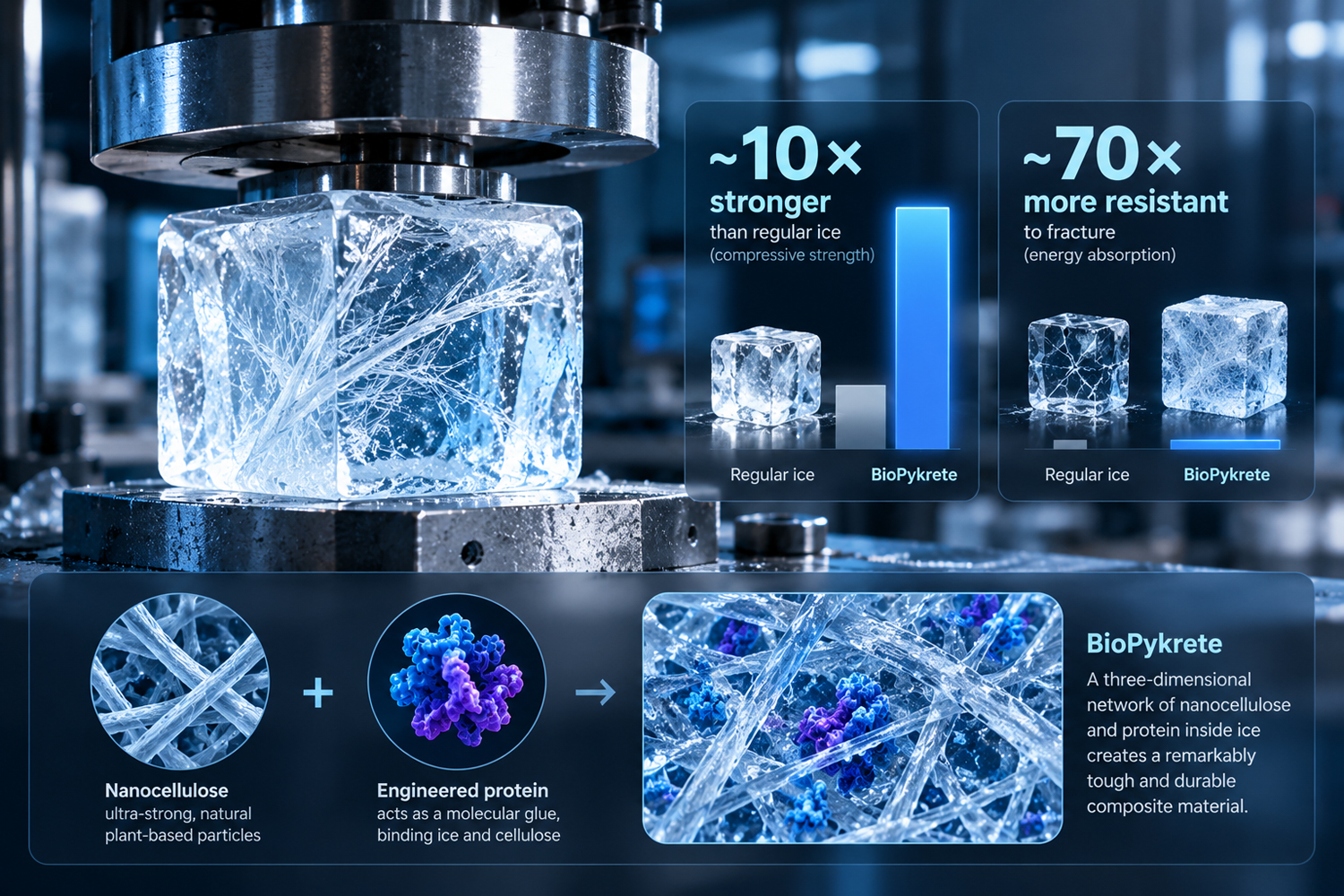
BioPykrete is formed by locking nano-crystalline cellulose into an ice matrix using a specially engineered protein — the result is a composite that rivals concrete in strength.
The numbers
Lab tests recorded in the September 2026 issue of Colloids and Surfaces B: Biointerfaces show BioPykrete absorbs roughly 70 times more energy before fracturing than plain ice. That means it deforms rather than shatters on impact — a critical property for any structural material in an environment where repairs are difficult and supply chains are thin. New Atlas frames it as a potential alternative to concrete for polar construction, where flying in steel or cement can cost many times the material's own price.
Still a lab prototype
The target environments are the Arctic and Antarctic, where logistics are punishing. A locally sourced, water-based building material that requires no long-distance shipping and leaves no persistent waste would address real problems in both scientific and commercial polar operations. The US Department of Defense, among others, funds research into extreme-environment materials — the biodegradability angle also fits the ESG criteria that construction and infrastructure funds now routinely track.
That said, BioPykrete remains a proof of concept. The research team has not yet published data on how the material holds up through repeated freeze-thaw cycles or under sustained structural load. No commercial timeline or production partner has been announced. The next hurdle is scaling the protein synthesis and testing long-term performance before the material moves out of the lab.


